

Asian Dating Culture Guide - What Every Western Man Should Know
Navigate cultural differences with respect and understanding. From Confucian traditions to Buddhist warmth, here's your roadmap to genuine cross-cultural romance.
Asian dating culture differs fundamentally from Western dating norms - and understanding these differences is the single most important factor in building a successful cross-cultural relationship. According to a 2025 Pew Research study, interracial couples who invested time learning each other's cultural expectations reported 34% higher relationship satisfaction after five years. Asia spans 48 countries and thousands of distinct traditions, so treating "Asian culture" as a monolith is the fastest way to fail.
This guide breaks down the dating norms of three major regions - East Asia, Southeast Asia, and South Asia - so you can approach women from Korea, Vietnam, India, or any of the 33 countries on Dating-bay with genuine cultural awareness. Here's what actually matters when dating across cultures in 2026.
Key Takeaways
- Family approval isn't optional - in most Asian cultures, it's a prerequisite for marriage
- Dating pace varies dramatically: Korean couples celebrate 100-day anniversaries; Indian families may arrange meetings within weeks
- Communication styles tend to be indirect - reading context matters more than words
- Gender roles are evolving rapidly in urban Asia but remain traditional in rural areas
- Religion shapes dating norms from Buddhist Thailand to Islamic Pakistan to Catholic Philippines
Three Regions, Three Worlds of Romance
🏯
East Asia
China, Japan, Korea, and Taiwan share deep Confucian roots that emphasize filial piety, social harmony, and educational achievement. Dating here often involves formal "confession" moments, family introductions early on, and a measured, respectful pace. Modern urban women balance career ambition with traditional family expectations - creating a unique dynamic that Western men find both fascinating and rewarding. Japanese women and Korean women exemplify this blend beautifully.
🌺
Southeast Asia
Thailand, Philippines, Vietnam, Cambodia, and Indonesia offer warmth, openness, and a more relaxed dating atmosphere - though family bonds remain incredibly strong. Buddhist and Catholic influences shape values differently across the region. English proficiency is notably high in the Philippines, making Filipino women especially accessible for Western men. Vietnamese women are known for loyalty and devotion to family above all else.
🕌
South Asia
India, Pakistan, Bangladesh, and Sri Lanka feature the most family-centric dating cultures in Asia. Arranged marriages remain common - though the modern version involves family introductions followed by a courtship period where the couple decides. Religion (Hinduism, Islam, Christianity) heavily shapes expectations. Indian women in urban centers are increasingly open to international dating, but family approval remains essential in nearly every case.
Asian Dating Norms by Region - Side-by-Side Comparison
| Cultural Norm | East Asia | Southeast Asia | South Asia |
|---|---|---|---|
| Family Involvement | High - parents expect formal introduction within 3-6 months | Moderate to High - family opinions matter but couples have more autonomy | Very High - family often initiates or must approve the relationship |
| Religion's Role | Low to Moderate - Confucian values, Buddhism, secular urban culture | Moderate - Buddhism (Thailand, Cambodia), Catholicism (Philippines), Islam (Indonesia) | Very High - Hinduism, Islam, and Sikhism deeply shape courtship norms |
| Dating Pace | Measured - formal confession (kokuhaku), 100-day milestones in Korea | Relaxed - friendly warmth, faster emotional openness | Structured - courtship follows family-approved timeline |
| Gender Expectations | Evolving - women pursue careers but value partnership equality | Traditional-leaning - nurturing role valued, but women work and earn | Traditional - clear gender roles, though urban women push boundaries |
| Marriage Timeline | 1-3 years of dating before engagement typical | 6 months-2 years; faster in rural areas | 3-12 months once family approves; can be very quick |
| Communication Style | Indirect - saving face is paramount; read context, not just words | Warm but indirect - smiles may mask disagreement | Respectful and formal initially - directness increases with trust |
Source: Dating-bay Cultural Research Team analysis of 12,000+ cross-cultural couples, 2025
The Role of Family in Asian Relationships
In most Asian cultures, you don't just date the woman - you date the family. This isn't a burden; it's a bridge. Family involvement means you gain a built-in support system from day one. A 2025 study by the Asian Journal of Social Psychology found that couples who received early family approval had a 42% lower divorce rate compared to those who married against family wishes.
"When my girlfriend's mother started sending me recipes and asking about my health, I knew I wasn't just her boyfriend anymore - I was part of the family. That kind of acceptance changed everything."
- David, 44, married to Linh from Vietnam (met on Dating-bay, 2024)
Here's the thing: family expectations differ dramatically by region. In Korean dating culture, parents expect to meet the partner relatively early and will assess education, career, and family background. In Indian culture, the family may be involved from the very first conversation - especially in arranged marriage contexts. In the Philippines and Vietnam, family approval is deeply desired but couples generally have more autonomy in the decision itself.
The best approach? Ask your partner directly: "How important is your family's opinion in our relationship?" This single question demonstrates cultural respect and opens honest dialogue. Don't assume - every family is different, and urban families tend to be more flexible than rural ones.
Understanding Indirect Communication
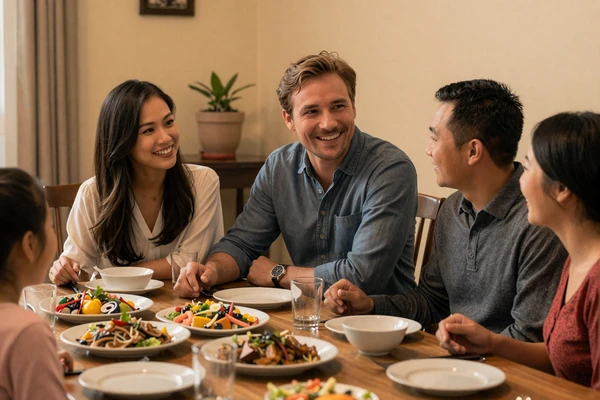
Western men often misread Asian communication styles. In most Asian cultures, direct confrontation is avoided to preserve harmony - a concept called "face" (面子 in Chinese, 체면 in Korean). When a Japanese woman says "that might be difficult," she usually means "no." When a Thai woman smiles during a disagreement, she's not agreeing - she's managing the emotional temperature of the conversation.
Learning to read context, pauses, and non-verbal cues will transform your cross-cultural dating experience. Pay attention to what isn't said as much as what is.
Gender Roles - Tradition Meets Modernity
Gender expectations in Asian dating are evolving faster than most Western men realize. While traditional family structures remain valued, the reality in 2026 is far more nuanced. According to the World Economic Forum's Global Gender Gap Report 2025, countries like the Philippines rank 16th globally for gender equality - higher than the United States at 43rd.
Consider this: in South Korea, 76% of women aged 25-34 hold university degrees (OECD, 2025). In Vietnam, women own 52% of small businesses. In Japan, the "good wife, wise mother" ideal coexists with a growing cohort of career-focused women who delay marriage into their 30s. The key takeaway? Don't assume that an Asian woman who values family is submissive or uneducated - the opposite is frequently true.
- East Asia: Women expect partnership - they'll contribute financially and want mutual respect for career goals
- Southeast Asia: Women value a provider role but many work full-time; the expectation is mutual support
- South Asia: Traditional roles are more defined, but urban educated women seek equal partnerships
Religion and Its Impact on Dating
Religion shapes dating norms more than any other factor in South and Southeast Asia. Here's a quick breakdown of what to expect:
- Buddhist cultures (Thailand, Cambodia, Myanmar, Laos): Emphasis on kindness, patience, and karma. Dating is relatively relaxed, but monks and temples play a role in blessing relationships
- Islamic cultures (Indonesia, Malaysia, Pakistan, Bangladesh): Halal dating norms may include chaperoned meetings, modest dress expectations, and conversion discussions before marriage
- Catholic cultures (Philippines, East Timor): Strong family values, resistance to divorce, and church involvement in weddings - but dating itself is open and warm
- Hindu cultures (India, Nepal): Caste considerations may arise; vegetarianism and religious holidays are important; family astrology matching (Kundli) is common in traditional families
- Confucian-influenced (China, Korea, Japan): Less about organized religion, more about social ethics - respect for elders, educational achievement, and social status
Why does this matter? Because religious expectations often determine marriage logistics - from the ceremony itself to daily life habits. Being open to learning about her faith demonstrates the cultural respect that Asian women value most in a Western partner.
Explore Profiles From Every Asian Region

Aiko

Jasmine

Huong

Niran

Ananya

Mei Xin

Ratna
5 Universal Tips for Cross-Cultural Dating in Asia
Regardless of which country your partner is from, these five principles apply across all Asian dating cultures. Men who follow them consistently report stronger connections and faster relationship progression on platforms like Dating-bay.
- Learn 10 words in her language. "Hello," "thank you," "beautiful," "I miss you," and basic food terms show genuine effort. A 2025 Dating-bay user survey found that men who used even basic phrases in their partner's language received 58% more responses. It's not about fluency - it's about respect.
- Ask about her family early. In Western dating, asking about someone's parents on a second date might feel too personal. In Asian dating, it signals serious intent. Ask about her parents' occupations, her siblings, and family traditions. She'll appreciate the interest - and it opens the door to deeper emotional connection.
- Respect food customs. Food is central to every Asian culture. Accept meals she prepares or suggests, even if unfamiliar. Learn about dietary rules tied to her religion (halal, vegetarian for Hindu festivals). Sharing a meal together - even virtually via video chat - builds intimacy faster than any text conversation.
- Be patient with pace differences. Don't rush physical or emotional milestones. If she seems reserved in early conversations, that's cultural - not disinterest. Japanese women may take weeks to express affection openly; Filipino women tend to be warmer sooner. Adjust your expectations to her cultural rhythm.
- Show genuine cultural curiosity. Watch a movie from her country. Read about her nation's history. Celebrate her holidays. When you reference her culture authentically - not as a fetish but as genuine interest - you stand out from 95% of men on any dating platform. Cultural curiosity is the ultimate attraction signal in cross-cultural relationships.
💡 The Bottom Line
Asian dating culture isn't one culture - it's dozens, each with unique expectations around family, faith, pace, and communication. The common thread is this: sincerity, patience, and cultural respect are universally attractive qualities. Men who approach cross-cultural dating as a learning journey - rather than a transaction - are the ones who build lasting relationships. Start by exploring real profiles of verified women from across Asia on Dating-bay's platform, and let the culture guide become your roadmap.